
Switch cabinet construction in Beckum – High-Speed Production with Industry 4.0
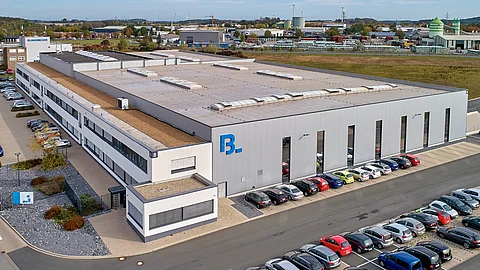
8,000 m² of production space, over 5,500 switch cabinets per year, series production starting at a batch size of 1—even with design changes made just before project completion. This is possible because our switch cabinet construction facility in Beckum (North Rhine-Westphalia) is consistently built on Industry 4.0 technologies: networked production stations, a central data cloud, and digital work orders for every single job. Here, we show how our manufacturing process works in practice—from material delivery to export control.
Additional features of our switch cabinet construction:
- Automated wire harness assembly with process monitoring
- High-bay warehouse with shuttle system for just-in-sequence delivery
- Digital assembly of functional groups with visual workstation guidance
- Sequential switch cabinet testing with automatic logging
Is your project on an international scale?
So is our manufacturing.
In addition to our main plant in Beckum, Blumenbecker manufactures switchgear at three other international locations—in Poland, India, and China. For you, this means local manufacturing closer to the site of use, shorter delivery routes, and a partner who supports your global projects from a single source.
High-Speed Switch Cabinet Construction with Industry 4.0
Serial production of switchgear starting from a batch size of one—due to the high degree of customization, this is only possible with state-of-the-art IT. In this context, setting up a central data cloud is of great importance for networked and flexible production stations. All levels draw the necessary data from this cloud. The data cloud thus prevents data redundancy and ensures a fast, transparent exchange of knowledge within the company. People, machines, and software are in constant communication with one another, thereby helping to ensure that switchgear of outstanding quality leaves the factory.
Milestones in Our Switch Cabinet Construction
Material logistics: receiving area
In the “Goods Receiving” section of materials logistics, at least 6,000 products from external suppliers are scanned daily using their item numbers and assigned to a specific order—that is, a switchgear assembly. The materials are then placed in a so-called “hopper” and transported via conveyor belt to a high-bay warehouse consisting of four towers, where they are sorted accordingly.
Materials allocation and virtual job card
For the first time, the virtual job card—equipped with QR codes—is used during material preparation. Using the information stored on the card, an employee gathers all the components needed for a project and loads them onto transport units. For larger switchgear systems, this may initially be only a subset, such as the materials for a terminal box to be manufactured. The virtual job card is then attached to the transport unit, which is subsequently fed into the actual production line.
CNC sheet-metal processing
The sheet metal fabrication center processes approximately 6,000 different mounting plates, doors, and other components each year. The assembly drawings are fully digitized. An employee first scans the order from the virtual work card and reviews the parts to be manufactured on the screen. At the push of a button, the command for sheet metal processing is then sent to the CNC machine. Any necessary tool changes occur automatically. All processed parts of a switchgear assembly are then subjected to a visual inspection and marked for the subsequent production process.
Automated cutting
At Blumenbecker, approximately 40,000 cable duct and DIN rail cuts are performed each year using fully automated cutting systems.
Cable assembly
The assembly of cables to be installed in the switch cabinet is also fully automated. The virtual work order is imported into the software, the work steps are transmitted to the processing machine and executed immediately, including the formation of cable sequences and bundles. Process and product monitoring is carried out throughout.
Function-group formation
Since every switchgear assembly consists of different functional groups—a functional group may, for example, consist of contactors and auxiliary contacts—the numerous components must be grouped accordingly. To this end, there are tables to the right and left of the employee, whose surfaces are divided into square zones. After scanning the virtual work card, the screen displays how many zones are relevant for the specific order.
The employee takes any item from the picking area, scans it, and immediately receives clear information—on the screen and on the storage surface via a flashing red hatch pattern—indicating which zone the item should be placed in. After confirmation by scanning again, the software receives feedback that the correct component is in the correct place. This process is repeated until a functional assembly is complete—which is also visually indicated. Subsequently, a printout of the relevant materials is generated automatically.
Quality check: switch cabinet testing
Once all functional modules have been installed and the switchgear has been completed, it undergoes a so-called sequential switch cabinet test, which is a tabular test procedure. The employee responsible scans the virtual work card that has been attached to the switch cabinet. Software developed specifically for this purpose retrieves the necessary information for the respective switch cabinet from the cloud and loads the required test sequence program, which is then executed step by step. All test steps are also monitored for time and statistically evaluated, so that potential recurring errors are immediately detected and can be corrected during production if necessary. At the end, the result is documented in writing in a test report.
Export Controls in switch cabinet construction
Since numerous switchgear systems manufactured in Germany are intended for export, it is of paramount importance for machine and plant manufacturers to have accurate information about components requiring export licenses that are installed in their switch cabinets. Here, too, Blumenbecker customers receive valuable support, as every switch cabinet leaving the Beckum plant is checked for items requiring a license. If necessary, this is followed by an automated customs declaration, the transfer of all export-related information to the customs system, the comparison of master data—including item numbers—with the customs system, and the documentation of the export control performed. For this purpose, Blumenbecker holds AEO (Authorized Economic Operator) certification, meaning it is a licensed exporter.

Professional electrical assembly worldwide
Blumenbecker offers expert electrical assembly, switchgear, and switch cabinet commissioning—from planning and site surveys to global implementation. Trained electricians work in accordance with the latest technical standards and ensure maximum operational reliability and future-proofing.
Thanks to our comprehensive expertise in cable tray and mounting systems, we provide everything from a single source: consulting, quotation preparation, detailed installation planning, experienced project management, and flexible material delivery for industrial electrical installations of any scale.

Standards and certifications
The production facility in Beckum is certified to EN 61439, UL 508A, UL 698A, ISO 9001:2015, and DIN ISO 45001:2018. As one of the few companies in Germany, Blumenbecker is authorized to label UL switchgear independently in-house—without an external inspector—which significantly speeds up exports to the U.S.
Learn more about UL standards and our Competence Center
Custom-built switchgear for complex large-scale projects
For the SMS group, we built the switchgear for a hydraulic drop-forging press—featuring more than 50 meters of switch cabinets and over 100 decentralized terminal boxes. Since the control software was written in-house by the SMS group, up to ten programmers worked at times in the test facility in Beckum to test bus connections and motors and evaluate the software directly in a practical setting.
Custom solutions upon request: special paint finishes and non-standard sizes, explosion protection according to ATEX and UL 698A, UL-compliant switchgear with in-house labeling, and automated export control via AEO-C certification.
FAQ: Frequently asked questions about switchgear manufacturing in Beckum
How many production steps does a switch cabinet go through in Beckum?
A switch cabinet goes through seven stations in Beckum: incoming goods, material preparation, CNC sheet metal processing, cable assembly, functional group assembly, switch cabinet testing, and export control. All stations are located in sequence—without any detours—and are controlled by the virtual work order.
What is the virtual job card and how does it work?
The virtual job card is a QR code-based control element that accompanies each order through all production stations. At each station, the employee scans the card and immediately receives the station-specific information from the central data cloud—which parts are needed, in which zone they are to be placed, and which test program to load. This eliminates data redundancies and makes every step traceable.
What does series production of switchgear starting at a batch size of 1 mean in practice?
Each order is assigned its own virtual work order. The shuttle warehouse provides the order-specific materials before the employee needs them. This allows production to continue without interrupting the production cycle, even if the batch size and configuration vary from cabinet to cabinet.
Can design changes still be made during production?
Yes. Because design and production are located in close proximity, changes made in EPLAN P8 or EEC One can be incorporated directly into ongoing orders—right up until shortly before completion. The digital infrastructure ensures that all production stations are immediately supplied with the latest data.
Does Blumenbecker in Beckum also manufacture according to UL standards?
Yes. Blumenbecker is authorized to manufacture switchgear in accordance with UL 508A and UL 698A and to label it in-house—without an external inspector. This means shorter project lead times for customers who have products manufactured for the U.S. or Canadian markets. Unannounced audits are conducted several times a year by an NRTL-recognized inspector.

Are you looking for a reliable partner for switch cabinet manufacturing?
Whether it’s a single project or a production run, we’ll meet your requirements on time and with the highest quality.
Contact us—we’d be happy to advise you and provide a customized quote for your switchgear.
Contact us

