
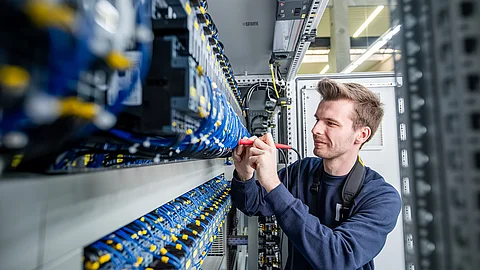
Have your switchgear inspected – Inspection service for electrical switchgear in accordance with DGUV V3

Inspections and maintenance of your switchgear
The machines and equipment have been installed and commissioned, the supplier has left the premises—and what happens next? Now it’s up to the system operator to ensure that the equipment runs smoothly. In the worst-case scenario, a machine could break down, potentially even bringing production to a halt.
Through regular inspections and maintenance, irregularities in the machines can be detected early and corrected before they pose a risk to the production facility. Our service team performs these inspections for you in accordance with the latest standards. You don’t need to worry about scheduling—we’ll automatically notify you at set intervals that an inspection is due soon. All you have to do is let us know the day that works best for your production schedule.

The following measures are defined under the terms of DGUV V3
- Original commissioning inspection in compliance with DIN VDE 0100-600
- Periodic inspection in compliance with DIN VDE 0105-100
- Inspection of portable equipment in compliance with DIN VDE 0701/0702
- Inspection of equipment in compliance with DIN VDE 0113 and EN60204
Failure to comply with these instructions may have serious consequences: loss of insurance cover, criminal prosecution and claim for compensation against those responsible in the event of damage or loss. In such cases the legislator will want to see a complete and continuous inspection record.
All the benefits at a glance
- No tie-up of resources and fixed cost increase by own personnel.
- We automatically perform all the periodic inspections for you.
- All the inspection protocols are stored in a database and can be retrieved for you at any time for presentation to the authorities and insurance companies.
- We have a high degree of knowledge about your requirements, your machines, your installations and your staff: there is no need for any detailed induction process or clarification of interfaces.
- We will handle the servicing and accountability side of things, leaving you free to concentrate on your core business.

Thermography of your switchgear
Nearly one-third of all industrial fires are caused by overheating electrical systems. With our thermographic inspections, we detect hot spots in your switchgear early on, thereby reducing the failure rate by 80%.
Your benefits:
- Early detection of potential risks and vulnerabilities
- Increased system availability
- Prevention of consequential damage
Additional services: Network analysis & plant modernization
In addition to all legally required inspections, we also offer:
- Analysis and certification of industrial networks
- Electrical thermography
- Maintenance, repairs, and upgrades of your switchgear
Your contact for switchgear inspection & maintenance
Our representatives will advise you on inspection schedules, additional services, and customized maintenance contracts—providing personalized guidance tailored to your equipment.

Customer project: Electrical thermography at TEO AöR
During a thermographic inspection of 45 switchgear units at the central wastewater treatment plant and 34 pumping stations operated by TEO AöR Telgte, Blumenbecker discovered a loose connection—a common cause of operational fires. The issue was resolved in time to prevent any damage from occurring.
More about this customer project

FAQ: Frequently Asked Questions About Switchgear Inspections
What inspections are required under DGUV Regulation 3 for switchgear?
DGUV Regulation 3 covers several types of inspections for switchgear: the initial inspection of the system in accordance with DIN VDE 0100-600, the periodic inspection of the system in accordance with DIN VDE 0105-100, the inspection of portable equipment in accordance with DIN VDE 0701/0702, and the inspection of machines in accordance with DIN VDE 0113 or EN 60204
When is my switchgear due for a periodic inspection?
For stationary electrical systems such as switchgear, DGUV Regulation 3 stipulates a standard inspection interval of 4 years—for certain types of facilities, this interval is reduced to 1 year. The exact interval is determined by the operator’s risk assessment. Blumenbecker ensures compliance on your behalf: We automatically notify you as soon as an inspection is due—you simply tell us the date that works best for your production schedule.
What are the consequences of failing to comply with DGUV V3?
If the required inspection is not performed, failure to do so may result in the loss of insurance coverage, criminal proceedings, and claims for damages against those responsible in the event of a loss. The law also requires complete documentation of all inspections performed.
What are the advantages of Blumenbecker’s inspection service?
You don’t need to allocate your own resources for the legally required inspections. Blumenbecker handles scheduling, execution, and documentation—all inspection reports are available at any time for authorities and insurance companies. Since we’re already familiar with your systems, there’s no need for a time-consuming onboarding process.
What are the benefits of a thermographic inspection of my switchgear?
Thermographic inspection detects hot spots in switchgear at an early stage—a typical warning sign of loose connections or overloading, which can lead to operational fires. With this additional service, Blumenbecker has been shown to reduce the failure rate by 80%.