

Robotic bonding High‑precision automated bonding and joining of materials
Repeatable adhesive application
Robotic bonding and joining provide an efficient solution for the precise and repeatable application of adhesives, sealants, and other joining materials within the manufacturing process. By implementing robotic automation, you achieve consistent joint quality, reduced material consumption, and increased productivity.
Bonding and joining technologies are widely used across various industries. A typical example is the automotive sector, where each vehicle undergoes dozens of bonding operations, for instance in headlamp assembly. However, these technologies are increasingly being applied in other industries as well, such as electronics (e.g., material application on printed circuit boards) and the production of household appliances.

Ensuring consistent joint quality and strength at every application point is a fundamental requirement in bonding and joining processes, regardless of accessibility or trajectory complexity. Blumenbecker offers a comprehensive portfolio of robotic solutions that reliably meet these demands. Our systems optimize both robot paths and material dispensing in real time, ensuring maximum precision, process stability, and repeatability of results.
We design and deliver complete robotic workstations tailored precisely to customer requirements, from process analysis and system design to implementation, service, and operational optimization.
Proprietary software for maximum process transparency
The ProDaSt application was developed based on a specific customer requirement to obtain accurate data on pressure and temperature during the bonding and press-fitting process of headlamps.
The application ensures communication between the PLC and higher-level IT systems via the TCP protocol. As individual PLC manufacturers use their own communication standards for control, diagnostics, and data transfer, integration between the control level and IT systems has traditionally been technically demanding and required knowledge of multiple protocols.
ProDaSt addresses this challenge by providing a vendor-independent interface that connects PLC systems with IT infrastructure. The application enables not only the transfer of data from databases to the PLC, but also reliable acquisition of process data from the PLC, which can then be stored for further analysis.
Communication is designed to be efficient and transparent: the PLC stores required data in predefined memory blocks, which can be easily accessed by higher-level systems without the need for direct interaction with PLC software. Data can also be written to the PLC in the same way. This approach significantly simplifies implementation and eliminates the need for additional complex software tools on the PLC side.
With ProDaSt, you always have access to accurate and up-to-date data on process performance and robotic cell operation. This enables not only effective monitoring, but also long-term optimization of quality and production efficiency.
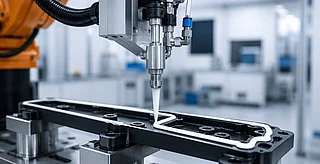

Key benefits of robotic bonding
- Consistent joint quality
- Precise material dispensing (minimized waste)
- Higher productivity and shorter cycle times
- Repeatability even for complex part geometries
- Capability for continuous operation (24/7)
- Process traceability and control (data, reporting)

Typical application areas
Automotive Industry
- Bonding of plastic and metal components
- Sealing of battery modules
- Joining of interior parts
Electronics
- Electronic potting
- Application of thermally conductive materials
Other industries
- Bonding of plastic products
- High-precision assemblies
- Consumer goods manufacturing

Design and implementation of robotic workcells
Every project begins with a detailed analysis of the production process. We design each workcell to precisely match your specific application.
Our delivery includes:
- application analysis
- technology testing
- workcell design
- implementation and installation
- operator training


