
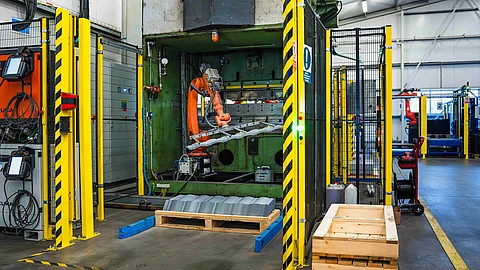
Robotic machine tending Efficient automation of routine manual tasks

Unlock the full potential of your production equipment
Automation of machine tending is no longer just a technological trend, but a key enabler for maintaining competitiveness. Robotic workstations help stabilize quality, increase production capacity, and reduce dependence on manual labor in critical operations.
Blumenbecker Prag delivers comprehensive robotic machine tending solutions for presses, CNC machines, injection molding machines, and other technologies. Each project is designed individually, with respect to the specific production environment, customer requirements, and future scalability.
Our goal is not just to supply technology, but to create a fully functional system that delivers measurable, long-term results.

From manual work to an automated process
The principle of robotic machine tending lies in precise synchronization between the robot and the machine. The robot automatically prepares the part in the correct orientation, loads it into the machine, removes it after the operation is completed, and transfers it for further processing.
The entire process runs smoothly, without unnecessary downtime and without the need for operator intervention. The robot responds to signals from the machine, adapts its working pace, and communicates with other elements of the production system.
A key advantage is flexibility. The robot can be reprogrammed for a new product or its function can be adjusted according to changes in the production program. Investment in robotization is therefore not a one-time solution, but a long-term step towards modern manufacturing and reduced production costs.

Applications of robotic machine tending across production
Robotic machine tending can be deployed across a wide range of manufacturing technologies. It delivers the greatest benefits in environments with repetitive handling operations, downtime between cycles, or processes heavily dependent on manual labor.
A well-designed robotic workstation significantly increases machine utilization, stabilizes quality, and enables smoother continuity between individual operations. At the same time, it helps reduce labor costs and enhances overall operational safety.
In practice, we most commonly encounter the following applications:
1. CNC machine tending
Automation of machining workstations is among the most common and economically efficient applications of robotics. The robot ensures continuous machine operation, minimizes time between individual cycles, and significantly increases machine utilization.
The solution includes:
- automatic loading and unloading of parts in precise orientation
- handling between machines
- palletizing and orientation of workpieces
- integration with the production system
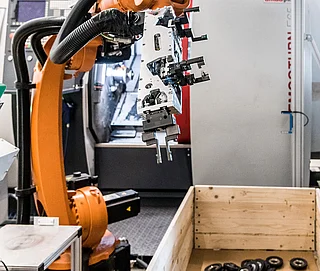
2. Robotic press and shear tending
Robots handle both material loading and unloading of finished parts, eliminating risks for operators while stabilizing the entire production process. The robotization of press operations delivers significant benefits not only in terms of productivity but also workplace safety, as it replaces physically demanding and potentially hazardous operations.
The solution includes:
- loading of semi-finished parts
- removal of stamped parts
- interoperation handling
- option for integration with part quality inspection systems
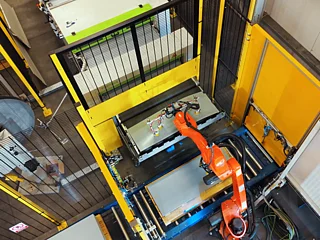
3. Robotic tending of injection molding machines
Robots enable fully automated operation of injection molding machines, including downstream processes. This significantly reduces the need for manual labor while ensuring consistent quality of plastic parts. The robot can directly follow the production cycle and seamlessly transfer parts to subsequent operations.
The solution includes:
- removal of plastic parts
- trimming and quality inspection
- stacking and packaging
- option for conveyor integration
- option for loading of inserts or semi-finished parts
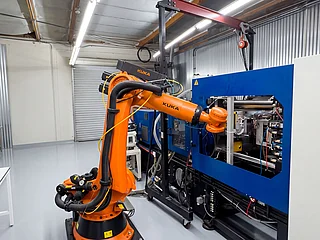
4. Additional applications
Robotic workstations can be further expanded with downstream operations, transforming simple handling into a comprehensive automated system. This enables optimization of material flow and seamless integration of individual production stages into a single functional unit.
Extensions may include:
- assembly operations
- sorting and packaging of products
- vision systems for quality inspection
- palletizing, including layer separation
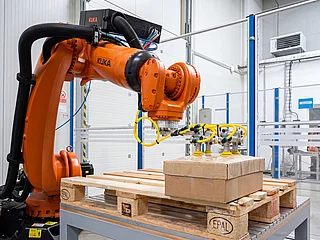

What results robotic machine tending delivers
Implementing a robotic workstation brings a fundamental change to production operations. A machine that previously depended on manual labor becomes a stable and predictable element of the manufacturing system.
Productivity increases through the elimination of downtime and optimization of production cycles. Quality becomes more consistent, as the robot operates with constant precision and without deviation.
At the same time, the working environment improves.
From an economic perspective, this is an investment that typically pays off within a relatively short period, particularly in multi-shift operations.

Design and implementation of robotic workcells
- Production analysis
We analyze products, line speeds, available space, and logistics requirements to design the optimal technical solution. - Technical design and 3D simulation
We create a 3D model of the entire line, verify cycle times, movements, and communication with PLC and MES systems, fine-tuning everything before installation. - Installation and commissioning
We deliver a complete robotic workstation, integrate it into the production environment, and test real operation to ensure a smooth start without downtime. - Training and support
We train operators to work with the system and provide fast service and ongoing technical support.

Robotics driving the future manufacturing
Robotic machine tending often represents the first step toward broader automation and digitalization of production. It enables the integration of individual processes and creates the foundation for a modern, flexible, and data-driven manufacturing environment.
Additional automation elements can then be gradually implemented, building a production system capable of responding to changes and optimizing performance in real time.
These solutions can also include Autonomous Mobile Robots (AMRs), which ensure flexible internal logistics and continuous supply of workstations. We are able to fully integrate these systems into higher-level production control, ensuring seamless cooperation with other technologies.

Interested? Contact our Sales Department
Lenka Hudrlíková
Robotics Sales and Marketing Manager


