
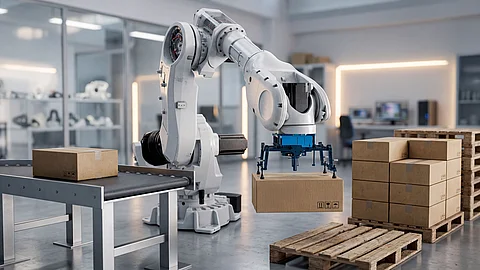
Robotic palletizing Efficient product stacking for increased production output

Flexible solutions
Automation of palletizing processes represents one of the most fundamental steps in the modernization of production and logistics. Companies are continuously facing increasing demands for speed, quality, and operational safety, and automated palletizing systems provide an efficient way to meet these requirements. Modern robotic workstations are capable of increasing the capacity of packaging lines by up to 15%, while significantly reducing the need for physically demanding, repetitive manual handling.
The result is more stable production, fewer errors, a significantly lower risk of workplace injuries, and overall more flexible and efficient operations.

Overview of benefits
- Predictable 24/7 performance
Automated palletizing processes operate at a constant speed and without performance fluctuations caused by fatigue or operator errors. Production thus becomes stable, predictable, and easier to plan. - Lower operating costs
Robots are able to replace physically demanding manual labor in the long term and minimize product damage during manual handling. As a result, both labor and logistics costs are reduced, and the investment typically pays back within a short period of time. - Improved workplace ergonomics and safety
Automation eliminates the need for lifting, carrying, and rotating heavy loads. The workplace becomes safer, the physical strain on personnel is significantly reduced, and the number of workplace injuries decreases. - Fast changeover of production variants
Thanks to working with lists of stored items, it is possible to quickly switch between different product types and palletizing patterns, which significantly reduces downtime during production changes. - High precision and repeatability
Robotic palletizing ensures repeatable accuracy and uniform distribution of products on the pallet, regardless of shift length or number of cycles. The result is more stable pallets, fewer complaints, and a lower risk of collapse during transport. - Easy integration with other parts of the production line
Automated palletizing systems can be easily integrated with conveyors, packaging machines, labeling systems, or warehouses. The entire line then operates more smoothly with minimal operator intervention.
Typical applications
Automation of palletizing processes is applied across a wide range of manufacturing and logistics sectors. Robotic palletizing is suitable wherever it is necessary to handle products quickly, precisely, and repeatedly, and to transfer them onto or from pallets. Robotic systems can easily handle cardboard boxes, bags containing bulk or granular materials, plastic and metal crates, transport containers, as well as special or irregular types of packaging.
Thanks to the wide weight range of handled components, it is possible to automate more demanding logistics operations that would otherwise represent excessive physical strain or be time‑inefficient if performed manually. Robotic palletizing thus proves effective in the food industry, pharmaceutical industry, e-commerce, manufacturing, as well as in heavy industry, where it is necessary to handle products with high weight or large dimensions.
View our implementation at Saker spol. s r.o. – o.z. Alusak
Technologies we use
Modern robotic arms used in our palletizing workstations feature high payload capacity, precision, and reach. Current models can offer a reach of over 3 meters, payloads of up to 800 kg, and a repeatability of up to ±0.5 mm, enabling reliable handling of both fragile and heavy products.
The solution can be enhanced with intelligent process control, including visualization and real-time monitoring. Operators can monitor the palletizing status at any time, adjust parameters, and respond quickly to production changes. Stored pallet configurations allow fast changeovers between individual production batches, significantly reducing downtime and increasing overall operational efficiency.
How our solution works
1) Production analysis
We analyze your products, line speeds, available space, and logistical requirements. Based on this assessment, we design the optimal technical solution.
2) Technical design and 3D simulation
We create a 3D model of the entire line, verify cycle times, robot movements, and communication with PLC and MES systems. All parameters are fine‑tuned before installation.
3) Installation and commissioning
We deliver and install the complete palletizing station, integrate it into your production environment, and test real operation to ensure a smooth start‑up without downtime.
4) Training and support
We train operators to work with the system and provide fast service as well as ongoing technical support.

If you are interested, please contact our sales department
Lenka Hudrlíková
Robotics Sales and Marketing Manager


